-
Writing for an Audience
Tech, Development Manager ·My day job is Senior Eng Manager at Shopify. Which means I manage a group of teams that ship software. I’ve tried writing about dev managing before, but never had much luck getting on a streak.
-
COVID and the End of the Streak
Fitness, COVID ·I was pretty fired up by James Clear’s Atomic Habits. The idea of building a habit and a streak over time resonated. I had managed to three months of exercising every day.
Then I got COVID.
-
Dogwood Blooming
Toronto, Renovation, House ·We landscaped our backyard about three years ago, after the big renovation we did almost ten years back!
My favourite piece of greenery is a dogwood tree that my wife insisted we plant.
-
Habit Tracker
Family, New Year’s, Fitness, Shopify ·You know that recency bias that happens when you learn of something, then you notice it everywhere? Well, that’s been happening with Atomic Habits.
-
Desmond Has a Bunker
Family, New Year’s ·Anyone remember Desmond from Lost?
-
Should We Even Do Resolutions?
Family, New Year’s, Fitness, Shopify ·no new years resolutions. it is the circumstances turn to improve
— Sarah Lazarus (@sarahclazarus) December 16, 2021 -
Last Year in Riding
Toronto, Fitness ·Like I said in Riding Goals, I had two goals in terms of riding this year:
- Break 2,000 km
- A long ride of 100 km
I smashed those goals and it feels great to be honest.
-
The Year in Review
Family, New Year’s, Fitness ·I’ve been thinking a lot about 2021. How it’s kinda seemed like shit. Like a poor sequel to 2020. However, the truth is that it’s only shit in comparison to my outsized expectations.
There’s a great line from my favourite singer
There was nothing to put me in love with the good life
I’m in league with the... -
Riding Goals
Toronto, Fitness ·I implied in A Year in Riding that I rode the bike a lot, because I managed approximately 1300 kms. It turns, that’s not a lot for a reasonably good recreational rider. I ended up joining the
#cyclingchannel in our work Slack, and some of those people are monsters on the bike.I had two goals...
-
Creativity for the Masses
Art ·An amazing clip of David Bowie came across my Twitter feed. He was doing a press junket on the now-cancelled Charlie Rose Show in support of the film Basquiat (he played Warhol).
-
Chesterton’s Fence and the Records We Don’t Keep
Tech, Development Manager, Shopify ·You know that thing where you are oblivious to a word or phrase, for your whole life, and then you hear it multiple times in the same week?
That’s “Chesterton’s fence” for me this week.
-
Being an Old Dev Manager
Tech, Development Manager ·I’ve been struggling recently with accepting where I am in my career. For the first time, I’ve been thinking about how old I am compared to my peers, and how the folks who are my age are now so much senior to me.
-
Why Write?
Tech, Toronto ·You have a blog ?!
– The Boy, incredulously
-
Only 70 Percent
Covid, Development Manager ·A leader at work whom I really respect recently posted in one of the Slack channels that they left 2020 at 0%. And that the two week break was only enough to get them back to about 70%, instead of what should have been 100%.
Man did that resonate with me.
-
Octopus Painting
Family, Art ·My wife loves cephalopods. I’m not sure where it comes from, but we have octopus art throughout our house. I like it too. Something so alien about them.
I decided to paint a picture for her birthday, and went looking for some inspiration.
-
The Last Dance
Chicago, Development Manager ·I lived in Chicago from 1994 to 2001. I was there for grad school, and one of the jokes about grad school is that you don’t get to be too involved in the social fabric because you’re working too many hours.
But if you were in Chicago in the 90s, there was no way to ignore the Bulls.
-
The New Year
Covid, New Year’s ·
-
Review The Year’s Goals
Family, New Year’s, Fitness ·“Plans are useless, something something …” – Eisenhower, maybe?
It’s that time of year again; retrospectives on 2020 abound. Obviously COVID is the major theme of the last year, but still, I think I should revisit what I set out as my goals in January.
-
Upgrading to Jekyll and GitHub Pages
Tech ·When I resuscitated this blog back in February, I had a number of things I wanted to accomplish around my domain. Mostly I wanted to move off the hosting provider that I used to have. While cheap, their mail service was pretty poor.
-
More Than a Year at Shopify
Tech, Shopify, Wave, Family, Featured ·I left Wave Financial almost 1 1/2 ago, and joined Shopify. I’ve been at Shopify for 15 months, and it’s been pretty intense. I’ll try to summarize why I decided to make the change and how it’s gone so far.
-
A Year in Riding
Toronto, Fitness ·I remember about four years ago, I was hemming and hawing about some big ticket items I was considering purchasing. A new suit, since I only owned two, and one I got married in. A new set of skis, the Rossi Soul 7s. Or a new bike.
Mulley quickly pointed out I’d wear a suit once or twice a...
-
So Say We All
Family, Vancouver, Covid ·This GIF came up in one of our Slack channels at work

And it reminded me of how much I loved Battlestar Galactica
-
Christmas gift lists
Family, Shopify ·At Shopify, we’re all about supporting small and local entrepreneurs and stores. Keeping with that motif, Shopify created the “Gift Better Guide” with various tastemakers and curators. My fav is Jon Wexler and JML because I didn’t realise Wex was a Chicago guy.
But just as solid …
-
Joe Biden and Kamala Harris
Family ·Well, I still don’t like November. However, with Joe Biden and Kamala Harris’s historic win, it’s starting to get better.
-
November Rain
Toronto ·Man, I really do not like November. And yet here we are.
Cue Slash …
-
Halloween 2020
Toronto, Covid ·When this whole thing kicked off in March, we really thought that it would be over by now. I naively believed that this was a SARS-1 or swine flu thing, not a Spanish flu once-in-century pandemic. Yet here we are.
Cindy and I started dating at a Hallowe’en party. Twenty odd years later, it’s the holiday that’s ours. We...
-
The Network
Toronto, Tech, Shopify, House, Covid ·Well. I said “I’m back” back in February. I guess COVID got in the way. However, one good thing about the fact that Shopify went to permanent remote work is that we got to improve our home networks.
Here’s what I did to improve my in-home networking.
-
The CN Tower
Toronto, Covid ·Because I’m missing getting outside and downtown right now, here are some photos of the CN Tower.
I can’t remember when I took the night shots. Maybe a Jays’ game?
-
George Graham, the Spanish Flu, and Now
Covid, Family ·I’ve been thinking a lot of my grandfather, George Patterson Graham. He was born in 1898 in New Glasgow, N.S., and was 17 when he was shipped to France to fight in WWI.
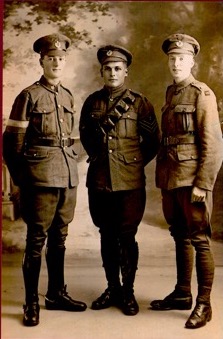
(That’s George on the right)
My paternal grandmother was my grandfather’s...
-
28 Days Later
Covid, Science ·
For most of Canada, it’s been five weeks of lock-down. We elected to go to the West Coast for March Break (the 14th to the 20th), back when the Covid scare wasn’t in full swing and we didn’t really know the impact that this virus was going to have on us.
We were fortunate...
-
Samples, Ziath, and Their COVID Response
Tech, Scimatic, Covid, Science ·When I was at Scimatic with Jamie, we worked to build our own product, Samples. Part of getting it to product-market fit was working with Neil Benn of Ziath to integrate Samples with Ziath’s 2D test-tube rack scanners.
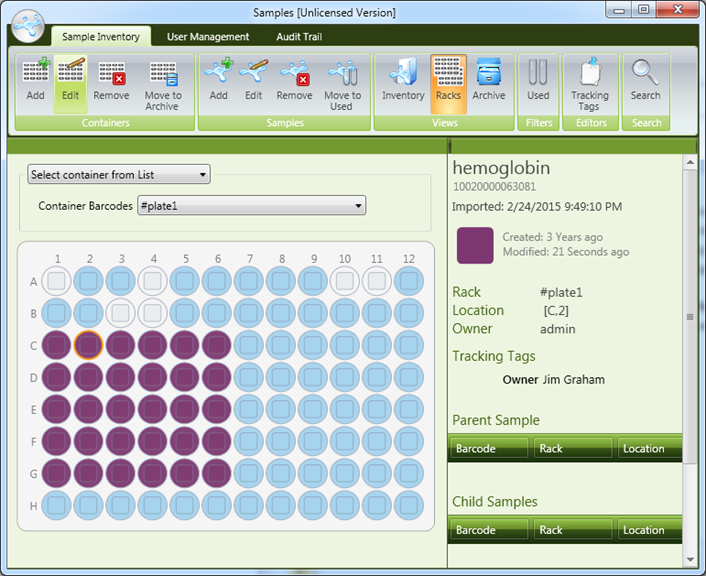
When we closed Scimatic down, we transferred the Samples software to Ziath because it was a...
-
Dev Managing …
Featured, Tech, Development Manager ·Someone at work asked me to write down what my expectations of a Dev Manager are. So here they are. These notes are cobbled together from my readings, talking and observing other Dev Managers, and a little bit of experience. I’ve added some resources at the end that might be helpful.
The most useful book for me personally is
-
Battlestations!
Toronto, Tech, Shopify, Covid ·We’ve all had to pivot very quickly to work-from-home in the Covid-19 era. At Shopify, we were sent home March 11th, and we’ve been on that WFH “war footing” ever since.
-
I’m Back!
Toronto ·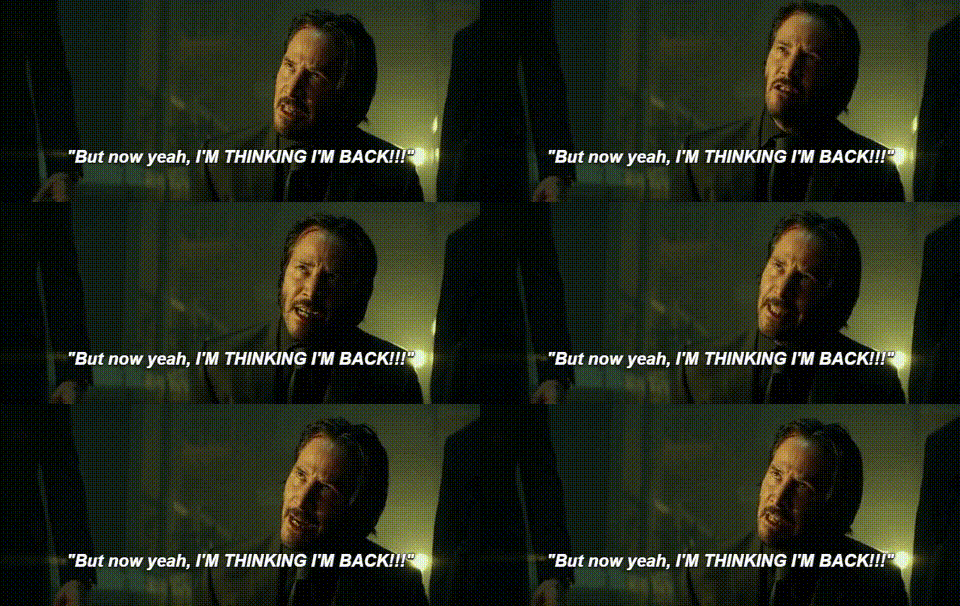
Been gone for 4+ years. But I’m feeling it’s time to write a few things down.
-
Surfing the Wave
Tech, Toronto, Wave ·
Exciting news! I’ve taken a position at Wave. I started September 8th.
-
The Science of Beer
Random, Toronto ·Saw this coaster at my local, The Auld Spot.
-
End of a Beginning
Featured, Scimatic, Tech ·February was my last month at Scimatic Software. Due to some changing markets and changes at some of our customers, Jamie and I decided that it was best to move on. He’s taken a role with Perkin Elmer, driving their software innovation group. I’m going to do some freelance work while I see where my next opportunity is.
... -
Capella for Capilix
Portfolio, Science ·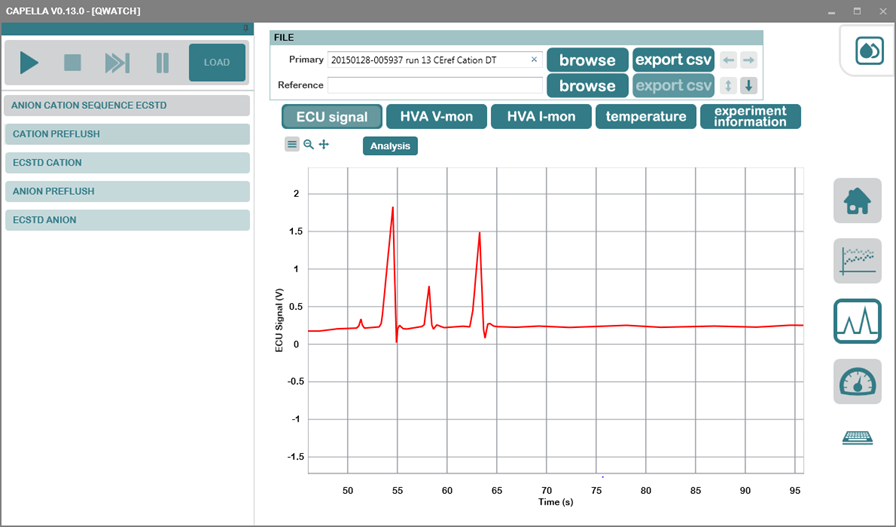
Capilix has created an amazing water monitoring product for industrial water processes.
-
Samples for Scimatic Software
Portfolio ·One of the best things about working at Scimatic was creating our own product, Samples.
-
Papers3 for Springer
Portfolio ·After the release of Papers for Windows, the Mekentosj team had a number of big events. They were acquired by Springer, they released Papers 3 for Mac, and they decided to rework Papers for Windows into Papers3 for Windows.
-
Github
Portfolio ·Is GitHub your new CV? I don’t think it should be, since not everyone has the opportunity to work on open source (see Ashe Dryden for the reasons why), and most of my work is in private repos.
However I did put some fun stuff that you might like on my profile.
-
CV – Academic Papers
Portfolio, Science ·Here is a sample of the papers I worked on while in graduate school. The KTeV Collaboration had approximately 80-100 people (professors, senior scientists, post-doctoral fellows and graduate students, plus engineers and techs) working on it at various times.
-
Collaborative Software for Scientists
Science, Scimatic ·Crossposted from the Scimatic Blog.
At Scimatic, building software for scientists is our raison d’être. Which is why we’re always excited to see the other folks in the space build stuff as well!
-
Building Built-in Bookcases from Billys, the Bridge
House, Renovation ·After part one of installing the Billy built-ins, here’s the next section.
-
New Online Authoring Tools for Collaborative Manuscripts
Science, Scimatic ·Crossposted from the Scimatic blog.
Our friend Kaitlin Thaney (@kaythaney) pointed out a newly funded collaborative editor company Authorea (@authorea) . Authorea would seem to be in competition with writeLaTeX (@writelatex) to corner the market on browser-based collaborative editors.
-
A Fond Farewell
Scimatic, Tech ·Crossposted from the Scimatic Blog.
We at Scimatic were very excited to work with Alex Greikspoor and his Mekentosj team to create the first version of Papers for Windows. There’s a lot of competition in the reference management space, from Mendeley and ReadCube, but Papers still stands out as...
-
Building Built-in Bookcases from Billys, the Beginning
House, Renovation ·After building the Pax closet organizer, I wanted to try my hand at a set of built in book cases. There are a number of how-to’s on the web, and this is a pretty common idea:
-
Installing a Pax Wardrobe
House, Renovation ·The major parts of our renovation are finished, but we continue to work on little details around the house. Plus there are items that I want to complete in a DIY fashion so I feel like I built something in the house.
In the previous incarnation of our master bedroom, the closet was far too small, to the point where...
-
Windows 8.1 on Boot Camp
Scimatic, Tech ·I recently got a new Macbook Air. I installed Boot Camp so that I could run my Windows development environment. Microsoft has a very straightforward reference for setting this up.
I purchased Windows 8.1 from the Microsoft Store, which was pretty easy. Running
WindowsSetup.exewill download the.isoor create a bootable USB drive. For the... -
Bulk Machine Setup via Chocolatey
Scimatic, Tech ·Cross-posted from the Scimatic blog. (I stole this idea from Scott Hanselman’s 2014 developer preview )
I just upgraded my ancient 2008 Macbook Pro to a nice shiny new Macbook Air, and one of the things I needed to do was to create a Boot Camp partition with the items I need for work.
-
Levelling the floor
House, Renovation, Toronto ·Slightly out-of-order post here. I wanted to go back and talk about how Tom leveled our floors.
As with most renovations of older homes, we found that the structure of the house had taken a bit of a beating with renovations that had occurred over the last 60 years. In addition, in that time, the back of the house had...
-
Science Outreach
Science, Scimatic ·Crossposted from the Scimatic Blog.
A few weeks ago, I took some time to do “science outreach” with my son’s Grade 3 class. Nothing fancy – the teacher had asked for volunteers for their “Scientist in the Schools” program. I had been the parent volunteer before, for units on recycling and insects, but this one was right up my alley...
-
SQLite and GUI Interfaces
Scimatic, Tech ·Cross-posted from the Scimatic Blog
A number of our projects use the SQLite database as a backend store. While developing, it’s critical to be able to see what’s in the database.
-
Congratulations to Mekentosj
Scimatic, Tech ·Crossposted from the Scimatic blog.
Last week, Alex at Mekentosj announced that they had been acquired by Springer Science + Business Media.
This is great news for Alex and his team, and really sets them up well for the future. The Mek team is a very agile team that gets a lot done, but as that post...
-
Keeping the Hot Side Hot
House, Renovation ·The insulation of the house was lacking, to say the least. After the previous owners had expanded into the attic, there was no insulation on the roof at all, and the only insulation on the exterior walls was some foam board added under the siding when the siding was bolted onto the house in the 80s.
-
In The Walls
House, Renovation ·I’ve been trying to update the blog with all the details of the renovation. The problem is that I take lots of photos, but Tom and his crew are working so quickly that I don’t get a blog post up in time, and they’ve already moved on!
-
New Steel
House, Renovation ·We decided to go “above and beyond” with the roof for the new house.
The standard roofing material in Toronto is a 25 year asphalt shingle applied to the roof, possibly with ice-and-water shielding tar paper underneath the shingles. The shingles can last up to 25 years, but with wind damage, one may have to make repairs as soon as...
-
So … They Probably Found The Higgs
Science, Scimatic ·Crossposted from the Scimatic blog.
One of the first blog posts I wrote for Scimatic, back 3 1/2 years ago, was about the LHC and the Higgs Boson. At the time, I had some doubts about whether or not it was a good idea to put all our physics eggs in one giant CERN basket, and I think...
-
Let the Sun Shine In
House, Renovation ·Paul the architect decided to big up the size of all the windows in the house, and it’s really made a huge difference.
The house already got quite a bit of sun, based on its east-west orientation, but by making the windows that much larger, we’re going to get that much more light. We had to change some of the...
-
Papers For Windows 1 0
Scimatic, Tech ·Crossposted from the Scimatic Blog.
We’ve had a very busy two months getting Papers for Windows ready for a 1.0 release. And just a bit after Earth Day, we decided to release! Alex and company at Mekentosj announced the release here along with their release of Papers for Mac 2.2.
The pre-release of Papers for Windows lasted...
-
Reinforcements
House, Renovation ·Tom’s guys, led by foreman Jon, have been hard at work beefing up the structure of the house. We knew that we would have to add some heft to the house, because our plan calls for opening up the main living space in the back, and the span of the second floor would be too big to do without a...
-
10+ Days with Papers
Scimatic, Tech ·Crossposted from the Scimatic Blog.
We released the first Papers for Windows pre-release on February 14th, and I’ve got to say, it’s been an exciting couple of days! We’ve learned a number of things from the release:
-
Demo!
House, Renovation ·Tom and his crew have started removing material from the inside of our house, and it’s quite a revealing process (see what I did there?) They say it’s going to take about three weeks, but they’ve already managed a lot of work in one. Amazing what four dedicated guys with crowbars can do.
-
Finally Getting Going
House, Renovation ·It’s been a bit of a long haul. We’ve been working for a while to get to the point where our renovation was under way, and work has finally started. The major sticking points were finding the right contractor, getting the building permits, and finding a place to live during the reno.
-
Papers for Windows
Scimatic, Tech ·Crossposted from the Scimatic Blog.
We’ve written a number of posts that talk about a client project that we’ve been working on for a while (NetSparkle, Xml Serialization, NHibernate, andDate Parsing)
Finally we can talk about what we’ve been working on, and we’re really excited.
-
Sparkly!
Scimatic, Tech ·Crossposted from the Scimatic blog.
We’re working on a client project where one of the requirements was a Sparkle-style updating mechanism. For those of you who are Mac folks, you’ll be familiar with the Sparkle “A new version of YOUR FAVOURITE APP is available!” window, with the options to skip, remind me later, or install the update.
Fortunately,...
-
Our Client Capilix Wins Aquatech Innovation Award
Scimatic, Tech ·Crossposted from the Scimatic blog.
Our client Capilix has won an Aquatech Innovation Award this year in the category of “Process Control & Automation”. That’s great recognition for the hard work the folks at Capilix have put into their product line.
-
Contributing to F/OSS and Dogfooding
Scimatic, Tech ·Crossposted from the Scimatic Blog.
Jamie sent me a link to a great review of the Business of Software conference, and before you think I’m going to go off on one of my business-analyst posts, I’m actually going to talk about “dogfooding”. The aforementioned review post talked about the best way to build a software product, and one...
-
Getting The Kitchen Planned out
House, Renovation ·We met with Yoko our kitchen designer last week. She and Cindy had met earlier to get the basics covered, and Yoko came back with her first set of plans for our new kitchen.
The biggest change to our house (with the exception of the dormers on the third floor) is that we are moving the kitchen to the front...
-
Let’s Crowdsource It!
House, Renovation ·Okay, we need some help from the interwebs.
We need to add dormers to our third floor, and we are investigating two possibilities. The first is a straight dormer, where the walls of the dormer come straight down vertically, and create another “wall” surface.
The second choice is a hip roof, where the wall of the dormer come down at...
-
Committee of Adjustments FTW!
House, Renovation ·I just got back from City Hall where we were in the Committee of Adjustments meeting. We were 14th on the list, so I got to hear all about the new critical care wing of St. Mike’s and a new restaurant on Dovercourt.
-
My Take on 204 Beech, Part 2
Toronto ·The debate around 204 Beech is blowing up.
I have been trying to read all that I can about 204 Beech. That means hitting “refresh” repeatedly on the #204beech Twitter search, reading the Save 204 Beech blog, and getting into the comments at OpenFile.
In my opinion, the best place to read about 204 Beech is
-
What is “Reproducibility” Anyway?
Science, Scimatic ·Crossposted from Scimatic
Titus Brown has a very funny spoof about how scientists will probably react to the NSF’s moves towards data management plans. Go read it, I’ll wait. After detailing all manner of horrible data, licensing and source code management techniques, he closes with
Meanwhile we will continue publishing exciting sounding (but irerproducible [sic])...
-
My Take on 204 Beech (Part 1)
Toronto ·Introduction
I wrote this a few days ago and didn’t publish it, because I wanted to think about it a bit. But now the story has exploded since Councillor Sandra Bussin has gotten involved against the Teehans. More details at the National Post and Open File. I hope to add more later.
Original
I’ve been...
-
Meeting the Neighbours
House, Renovation, Toronto ·Because we are going in front of the Committee of Adjustments, Paul the Architect recommended that we show our preliminary plans to our neighbours so that they won’t be surprised when they get a letter from the city informing them of the hearing about our changes.
So far, it’s been a great opportunity to introduce ourselves to the neighbours,...
-
Called In Front of the Committee!
House, Renovation, Toronto ·We’re going to the Committee of Adjustments.
The City has confirmed what Paul our architect suspected. The ‘pre-application law’ review showed that our plan to use our third floor will put our usable floor space of our house above 60% of the area of our lot. Since our neighbourhood is zoned as ‘R2 Z0.6’, we are only supposed to be...
-
First Sketches!
House, Renovation, Toronto ·Last night Cindy and I met with our architecture/design “team” of Paul and Yoko. Paul had sent Yoko and one of his other employees, Mike, to do detailed measurements of the house as it currently sits. From those measurements and the survey, they came up with some suggestions for directions to go with the design, and a plan.
Paul had...
-
Starting Over With The House
House, Renovation, Toronto ·We’re finally getting around to renovating our house.
We were extremely lucky to find our house when we did. We had given up on house hunting as we had lost out on three bids on previous houses (one under dubious circumstances). We happened upon this house somewhat by accident, and decided to buy it based on the fact that that...
-
Most Fun Day Skiing Evah
Featured, Random ·Found this photo after my wife was cleaning up the office.
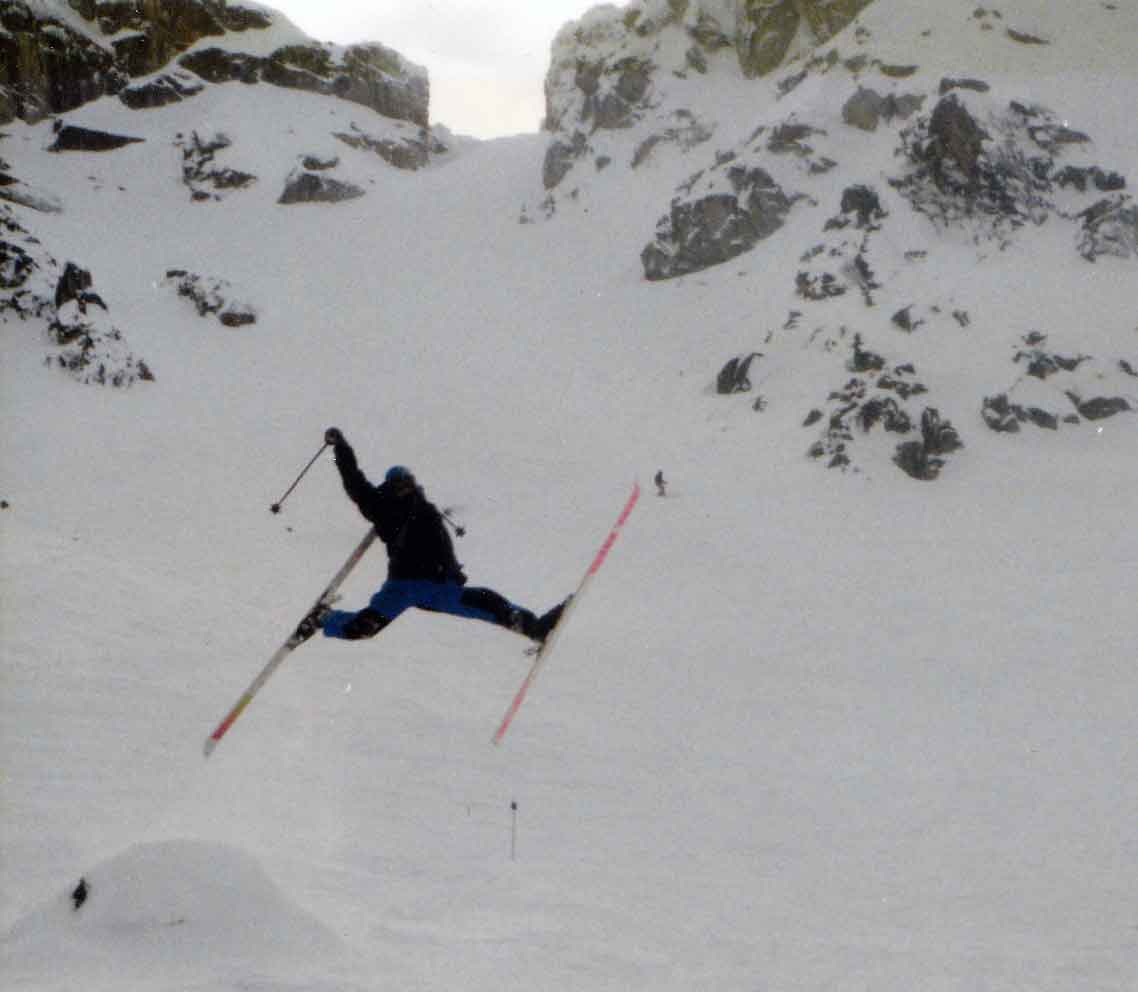
Chris Miller throwing an awesome old-school 80s style daffy at the base of Pakalolo on Blackcomb.
Possibly the best photo I’ve ever taken.
-
One Year Gone
Scimatic ·Cross-posted from Scimatic
I find it hard to fathom that it’s already been one year since I joined Scimatic. It’s been a great year full of exciting developments, and I think that we are well-poised to do some more great stuff in the future.
In the past year, we’ve done a major project for one of our European clients,...
-
I Feel The Same
Random ·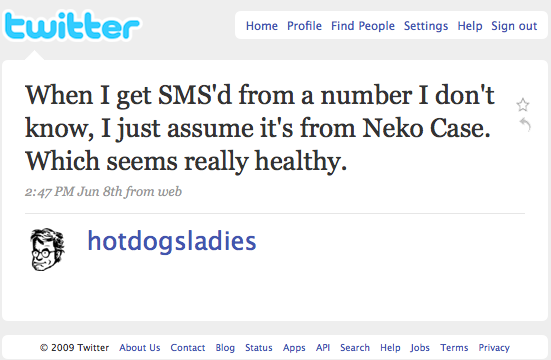
Especially about the “really healthy” part.
-
Bring the Cyclone
Random ·My wife and most of friends are aware of my deep love for Neko Case. So when I was at the Spadina TTC station and saw this poster,

I started to think, “How more awesome can Neko get?” And the answer is “None, none more awesome.” Check it out – Neko, fast...
-
Oh The Irony
Random, Vancouver ·So it’s our fourth day here in West Vancouver for our Christmas break. We come back to BC every other year, and I get really excited for it. I love Christmas with the whole Graham family, and this will be the first year that Iain will go into ski scamps.
Except it won’t.
-
Big Ups to the … Passport Office?
Random ·My passport expired in November, and I feel that I have to have a valid passport. Just in case I get The Call and have to leave the country in the dead of night. The last time I went through the process, it was a giant pain in the ass, as I had to get a new birth certificate from...
-
Illinois — How I Miss You
Random ·Even though he was convicted, I actually like former Illinois Governor George H. Ryan. He was two for three for me; he promised to fix the Hillside Strangler, and did; and then he put the death penalty on hold. So he sold fake licenses through the Secretary of State’s office. This is Illinois, after all.
Now there’s
-
Malcolm Gladwell and Outliers
Random, Toronto ·Cross-posted from Scimatic.com
Was out at UofT’s Convocation Hall last night, where I got to listen to Malcolm Gladwell riff on, well, lots of stuff.
Gladwell has always been one of my favourite writers, not only because he writes well and raises interesting questions, but also because he’s one of the only writers I know who is willing...
-
Happy Thanksgiving
·Hope all my folks and friends down in the US have a great Thanksgiving. I’d love some turkey and apple pie, so save me a slice.
-
Fired Up, Ready To Go
·It’s been non-stop election coverage around here. I’m going a bit crazy about it.
But I’m going to assume the best about my friends, family and fellow Americans (even those, like me, living in another country) have done or are doing the right thing and voting for Barack Obama. Most of the people I know live in traditionally blue states...
-
Thanks
·I worked for 16 weeks one year in Columbia, SC, with a great group of folks down at SCANA (including the guy who won $100,000 from America’s Funniest Home Videos for his quadruplets). The best contact I met there was Rick Kirkland, all-around great guy.
Rick had a tradition of calling people up on Thanksgiving to personally thank...
-
So … Found The Higgs Yet?
Science, Scimatic ·Cross-posted from Scimatic
The Large Hadron Collider at CERN turned on last week to much fanfare. It managed to make Google’s front page image. Fortunately, they avoided this. It’s quite a technical achievement, decades in the making, and the LHC is the "undiscovered country" of experimental particle physics. However, I have mixed feelings about it.
-
Network Effects
Scimatic ·Cross-posted from Scimatic.com
Jen Dodd wrote to the attendees of SciBarCamp 2008 to ask “… what has happened for you because of SciBarCamp. New business contacts or opportunities? New research projects? New artistic collaborations? New directions in your work or education?” Well, for me the impact of SciBarCamp was pretty huge.
-
How Come I Wasn’t Informed Of This?
·Seriously. I’m sitting in the theatre for The Dark Knight (aside: Totally Awesome. Loved it. Wicked. Go see it. Big ups to my friend Matt’s wife who was second assistant accountant on the shoot, and hence associated with something way cooler than I’ve ever done), when the trailer for The Watchmen came on. Within about 6 seconds...
-
New House
Toronto ·We bought a new house!
Pretty exciting stuff, as it is a detached house in a slightly better area. By that I mean that we are now in the school catchment that we wanted to be in so the kid can go to JK with all his friends from his daycare. Still in the same neighbourhood, so all the same...
-
Damian Conway Blew My Mind
Perl, Tech, Toronto ·Two nights ago I attended Damian Conway’s excellent talk: “Temporally Quaquaversal Programming In Multiple Topologically Connected Quantum-Relativistic Parallel Timespaces … Made Easy!” My notes said that he left out the “Virtual Nanomachine” part of the talk title, although he did talk about virtual nanomachines.
The talk was a preview of the keynote session that Damian will be giving...
-
New Contact Cards
Tech ·Now that I’ve left my job at OpenMake, I needed new business cards. But really they are more like “contact” cards as I don’t yet have a business.
My wife (and the rest of the blogosphere) is a big fan of Moo Cards. And now they’ve started printing business cards in the standard sizes. So I made up...
-
I Went To Detroit Eatery For a Burger … And All I Got Was The Stanley Cup
Random, Toronto ·So my friend Pat The Lawyer and I went for lunch. I felt like a burger, so I suggested we go to Detroit Eatery on the Danforth. Good burgers and a pretty cool place – school kids at lunch sitting besides regulars and the hipsters, too.
The place is crazy decked out with Red Wings memorabilia, to the point...
-
New Day Dawning
·Well, I left my job.
I was employed for 6 1/2 years at Catalyst Systems/OpenMake software working on build management tools. I’ve decided that I needed to take some time off and figure out what the next move in my career was going to be, seeing as I’m 36 and I want to make sure that the next 10 years...
-
The Intrinsic Awesomosity of the Interwebs
·My washing machine broke on Monday.
Suddenly, it wouldn’t start the spin cycle or drain the water from the drum. And that left my towels soaking in a pool of dirty sudsy water, which I had to bail out.
The last time the door latch broke on the washing machine, it was $200 just to get the guy in the...
-
Tuesday Fitness Update
Fitness ·Whoa, 180 pounds. Not good.
I’ve been back from Vancouver and Whistler for about 10 days now. I got to go skiing three of the days I was there, and I made the incorrect assumption that I was skiing so hard and burning so many calories that the food intake didn’t matter. And that the beer intake didn’t matter. It...
-
Monday Fitness Update
Fitness ·Went two weeks without checking in here – have to get focussed again.
Weight was 176 lbs. Good direction, and I’m doing well with not drinking cola. I had one last week and it didn’t taste very good. Still having a few beers, though.
Next is to get the exercise ramped up. Soccer seems to be on hold indefinitely, so...
-
Monday Fitness Update
Fitness ·Good news: 178.5 lbs, still no cola, down on the alcohol.
Bad news: no additional exercise and indoor soccer got postponed for a week.
-
The Backup Strategy
Tech ·They say you have to back up. Back up your data or you’ll regret it. Well, now I’m pretty aware of why you need the backups, because of two recent events. In the first, the backups worked; the second, they didn’t.
In the first case, (the one that worked), my wife and I had to transition our iPhoto library. We...
-
Monday Fitness Update
Fitness ·Got on the scale today. Still 180 lbs, no change.
The good news is that I’m way down on drinking Coca-Cola. Haven’t had any for a week, and I’m not really missing it.
The bad news is that I’m way up on alcohol – we had the annual-ish boys steak night on the weekend and restraint went out the window....
-
New Year’s Resolutions — Fitness
Fitness, New Year’s ·Well, it’s that time of year again, to think about how to make the next year even better. I’m going to post a few resolutions so that they are in a public place. I hope that will motivate me to keep to my commitments.
For the fitness aspect, I realise that I have to get into better shape. I’m not...
-
Toronto Real Estate
Toronto ·The wife and I are sitting around, trying to figure out if we can buy a new house. We’re looking to move slightly up into a different school catchment, but stay in the same overall ’hood. So I cooked up a spreadsheet that calculates all the variables that I could think of:
- What we’d sell this house for
- The...
-
Eclipse on Mac OS X Cocoa
Tech ·Just got my new MacBook Pro laptop up and running, and I’m stoked with it. I really dig working on it. I also dig Eclipse as an IDE and development platform. So, it was interesting to see these two coming together: Steve Northover has posted about how he was working at Apple to get SWT (the core of Eclipse)...
-
First!
·This is my first post to my blog. I hope there will be more to follow.

What I’m thinking